


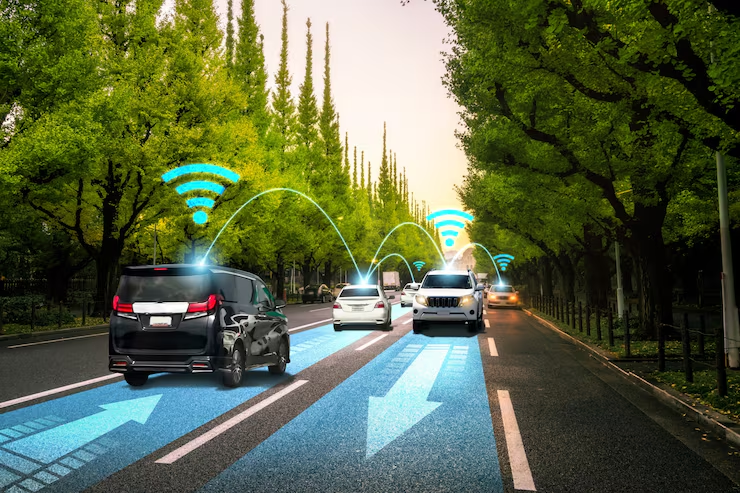
You are driving through a busy city street where traffic is unpredictable, pedestrians move suddenly, and every second demands attention. In this environment, even a small distraction can lead to serious consequences. This is exactly where the revolution of Road Safety in Modern Vehicles Today and Smart Driving Systems is changing everything.
Modern vehicles are no longer just mechanical machines. They are becoming intelligent safety partners, designed to think, react, and assist in real time. From automatic braking to AI-powered lane control, smart driving systems are redefining what it means to be safe on the road.
This is not the future of driving—it is happening right now.
The New Era of Road Safety
Road safety has evolved far beyond seatbelts and airbags. While traditional safety features still matter, today’s vehicles are equipped with advanced digital intelligence systems that actively prevent accidents before they happen.
Modern road safety focuses on:
- Predicting risks before they occur
- Assisting drivers in real time
- Reducing human error
- Improving reaction speed
- Enhancing awareness of surroundings
This shift marks a major transformation in global transportation safety standards.
What Are Smart Driving Systems?
Smart driving systems are advanced technologies built into modern vehicles to assist drivers and improve safety. Read expert insights about Road Safety in Modern Vehicles Today Global now.
These systems include:
- Advanced Driver Assistance Systems (ADAS)
- Automatic emergency braking
- Lane keeping assistance
- Adaptive cruise control
- Blind spot detection
- Traffic sign recognition
Together, these systems act like an intelligent co-driver that never gets tired or distracted.
How Smart Driving Systems Improve Safety
Modern safety systems are designed to respond faster than human reflexes.
Here is how they protect you:
- Collision Prevention
Sensors detect obstacles ahead and automatically apply brakes if the driver does not react in time.
- Lane Stability Control
If the vehicle starts drifting out of its lane, the system gently corrects steering or alerts the driver.
- Safe Distance Management
Adaptive cruise control maintains a safe gap between your car and the vehicle in front.
- Blind Spot Monitoring
Sensors detect vehicles that are not visible in mirrors and warn the driver before lane changes.
- Traffic Awareness Assistance
Modern systems read road signs and help drivers stay aware of speed limits and traffic rules.
Advantages of Road Safety in Modern Vehicles Today and Smart Driving Systems
The Road Safety in Modern Vehicles Today and Smart Driving Systems brings powerful advantages that are transforming driving experiences worldwide.
- Reduced Human Error on Roads
Most accidents are caused by distractions or delayed reactions. Smart systems help eliminate these risks by responding instantly.
- Faster Emergency Response
Modern vehicles can react in milliseconds, applying brakes or adjusting steering faster than human reflexes.
- Improved Driver Confidence
Drivers feel more secure knowing intelligent systems are constantly monitoring road conditions.
- Safer Long-Distance Travel
Smart systems reduce fatigue by assisting with speed control, lane keeping, and traffic awareness.
- Enhanced Passenger Protection
From children to elderly passengers, everyone benefits from advanced safety features.
Artificial Intelligence in Modern Driving Systems
Artificial intelligence is the core of smart driving technology.
AI helps vehicles:
- Analyze traffic patterns in real time
- Predict potential collisions
- Learn driver behavior
- Make instant safety decisions
This creates a system that becomes smarter with every journey.
Sensors and Cameras Powering Road Safety
Modern vehicles rely on multiple technologies working together.
These include:
- Radar sensors for distance measurement
- High-resolution cameras for visual tracking
- Ultrasonic sensors for parking assistance
- Lidar systems for precise environment mapping
Together, they create a 360-degree awareness of the vehicle’s surroundings.
Why Smart Driving Systems Are Becoming Essential
Modern road conditions are more challenging than ever.
Drivers face:
- Heavy traffic congestion
- Distracted driving risks
- High-speed highways
- Sudden pedestrian movement
- Poor weather conditions
Smart driving systems help manage these risks effectively and improve overall road safety.
The Role of Automation in Safety
While full self-driving is still evolving, partial automation already plays a key role in safety. Explore how road safety is evolving and See Full List of modern innovations available today.
Current features include:
- Semi-autonomous steering support
- Automated braking systems
- Speed adjustment assistance
- Parking automation
These systems reduce stress and improve control in difficult driving conditions.
How Smart Systems Reduce Road Accidents Worldwide
Globally, smart driving systems are helping reduce accident rates by:
- Preventing collisions before impact
- Reducing driver fatigue
- Improving reaction times
- Enhancing situational awareness
This is making roads safer in both developed and developing countries.
Future of Smart Driving and Road Safety
The future of road safety is moving toward fully connected and intelligent transportation systems.
Upcoming innovations include:
- Vehicle-to-vehicle communication
- Smart traffic infrastructure integration
- Fully autonomous driving systems
- Predictive accident prevention networks
These technologies aim to make accidents extremely rare in the future.
A Smarter and Safer Driving World
The Road Safety in Modern Vehicles Today and Smart Driving Systems represents a major breakthrough in global transportation safety.
With:
- Intelligent driver assistance systems
- AI-powered decision-making
- Advanced sensor technologies
- Real-time road monitoring
- Automation support features
Modern vehicles are becoming active safety partners instead of passive machines.
For drivers, this means greater confidence and reduced stress.
For passengers, it means enhanced protection and comfort.
And for the world, it means a future where roads are smarter, safer, and more connected than ever before.
